I marveled at its simplicity and effectiveness, and wanted to know more about it... after I was done playing with it :-)

For boys from 8 to 80, luckily I still fit :-)
It was too much fun, hence the historical details were sketchy in my last post.
Since then, a lady friend of mine dropped in and noticed my kitchen table covered in antique tools. She had that look that meant: Heather hasn't been around for a while, I see... Oups, busted, better pick up and clean up :-)

So I did...
Once my tools were banished to the woodshop downstairs, I found time between here (clean up(s), there was apparently more areas than I knew that needed to be done :-) and there (Rudy) for more research into that little guy. And then there were more chocolate runs (Tm) :-)
Must keep table cleared.... (repeat to myself)
This is what I found...
When you have a Patent No it is always an easy way to get lots of details: inventor, town, company etc.
In this case we have the next best thing, a Patent date. Aug 21-1923
Looking it up in DATAMP we find only 6 patents (woodworking related) issued that day. This is one great advantage of looking thru DATAMP, you only look at woodworking related patents, it quickly narrows it down.

Of the 6 only one is about Scroll saw
Our Patent is No 1,465,651 issued to a Mr C.A. Moberg. So it was not invented by Tautz after all, but manufactured by his company: Delta Specialty Co.


The original patent's drawing do not feature
the flywheel which was added to the crank handle
Another interesting lead found on this screen is the link referencing
"Vintage machinery" entry for Delta Specialty Co
humm 34 publications and under photo index found this page
on the American Boy Scroll Saw
One of the first thing that strike me when I started looking at pictures and catalogs text on line was some differences in the wheel pattern, base differences in size and either black or red, The working table went from round to square and changed size etc.
So I tried to come up with a more detailed knowledge surrounding this tool and its influence. Influence ? you ask? Yes, it truly was an innovation and it left an interesting legacy, one that affect us to this day in our woodworking hobby pursuit.
IN THE BEGINNING
Around the late 19th to the early 20th century, fret sawing was a popular hobby with Gentlemen and children (monkey see, monkey do :-). The craze even was popularized with the elaborate Ginger bread ornamentation on houses, but you either used a hand saw or a pedal power machine, such as Barnes, (notice in the video that he is cranking the pedal backward?)
Nice and dandy but that would probably not be affordable for the mass, especially to give to children...
So a classic "toy kit" of the day would have been something like that


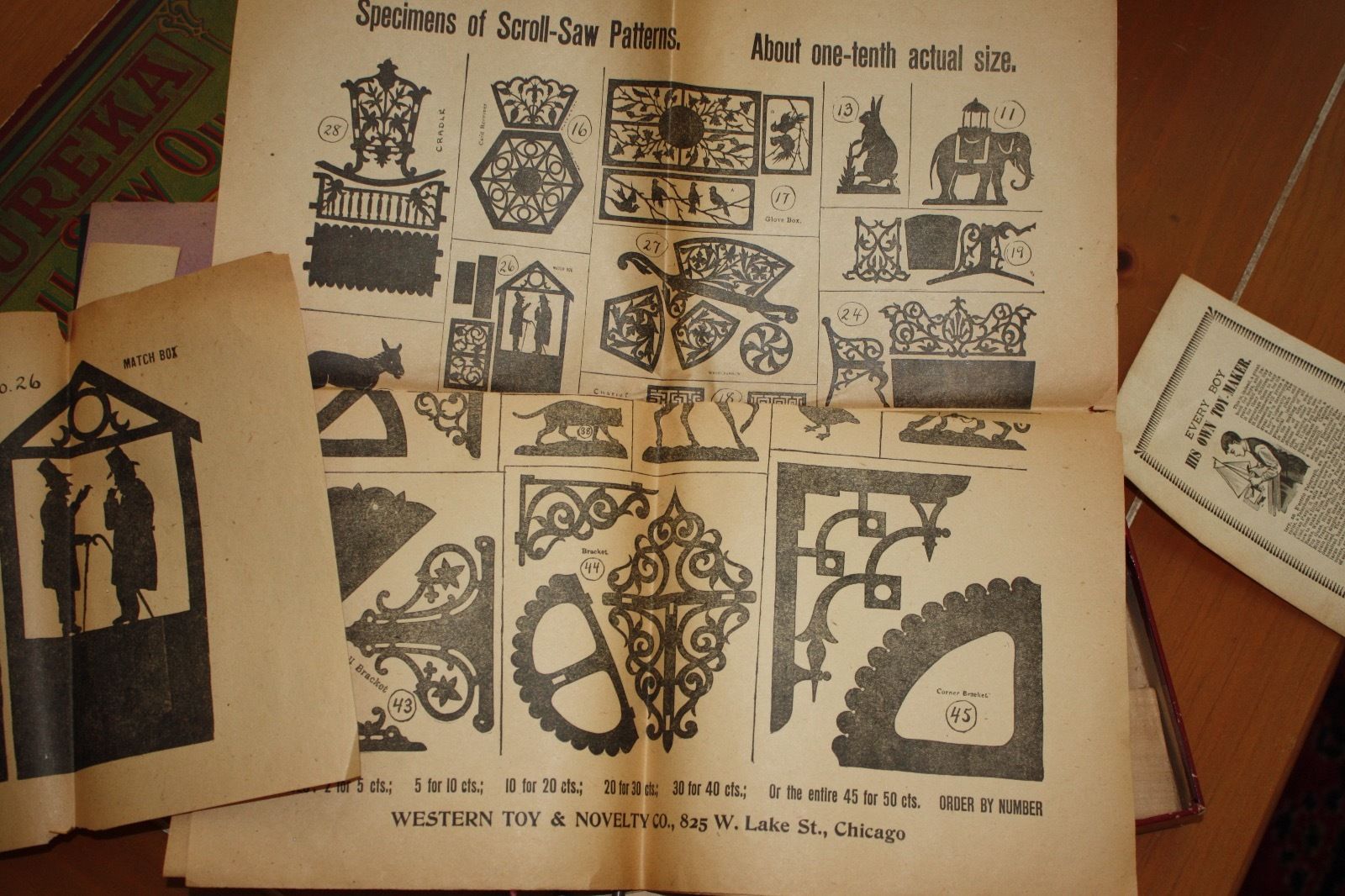

From the above hand tool kit

From The Delta American Boy Saw 1925 instruction pamphlet
The philosophy at the time was that every boy had within himself, destructive and constructive abilities within themselves. It was therefore important that, you, as a parent, give the child the abilities to explore and developed those creative abilities and minimized those natural destructive tendencies...
Give the boy the tools and materials he need to build things (keep him out of Dad's tool). He will learn the values of thing (selling them to make pocket money). And he will be too busy to get into trouble, everyone wins!

With this giant Erector set from 1919, you could let him develop
his constructive and destructive tendencies at the same time, bonus!
Look how strong my bridge is..oups, was. Sorry about your car Dad :-)
What Delta introduced in 1923-24, was truly a revolutionary little tool. Inexpensive to make, very rugged, can be used by cranking a hand wheel, or by attaching a belt to a foot treadle or a small electric motor (Just like Singer sewing machines until the early 60s could be powered by hand cranks, treadle or electric belt driven)
And because of its more efficient speed, you can crank out production and make more money faster...hum

Turn your Boy into a Boy Toy factory...what!!! :-)
And our story start here.... (Adapted from original copies from catalogs plus my own embellishments)
The American Boy Scroll saw was designed and developed to meet the great demand for an improved coping saw. While the ordinary coping saw frame cost very little indeed, it has many faults and disadvantages. For instance it require a great deal of skill to produce a square and straight cut, and the least edging or wiggling will results in breaking the blade. To work with an ordinary Coping saw frame is tiresome for the right as well as the left hand.
That last fault is greatly exaggerated, a good fret or scroll saw has a light balanced frame, but not all saws were created equal...
The American Boy Saw is the only saw selling at such a remarkable low price which eliminates all of the above named faults.
In 1925 it cost US $5.95 for the complete outfit, instructions and spare blades.
The flywheel and crank action with its great leverage, is responsible for the exceptional ease of operation. All users of the saw have been delighted with the perfect smooth and square cut. (Sic)
A steel V guide underneath the work table reduces blade breakages to a minimum


The V guide block is adjustable in-out and lockable
THE BASE
The first model introduced in 1923 or thereabout, were like my model

Square cast base, painted black
Which had a bigger, heavier base, still black

Notice the bigger size of the sliding cross head for the crank

Notice also, the 4 holes in each corners are replaced by two open slot holes.
This would come handy for what is about to come...

THE WHEEL

The "Giant" model had a different flywheel/pulley and crank.
Instead of three spoke such as mine, it had round holes.
It now measure 7-1/4 in, was 4-3/4 on mine.
That should gives the wheel more mass.
Note in this pic, it is missing the hold down, as is often the case.
Pic from EBay
The original table was a 4-1/4 inch diameter.. That was later increase at the time of the Giant model release, to a 4-1/2 in square table.
A 5-3/4 in square table was introduced with the Giant, which utility was greatly enhanced by adding a tilting mechanism to it.

THE FRAMES
Besides the Giant and the regular, there was two sizes of throat openings available: They normally came with a pair of 8 inches frames, but you could specify or order separately the 12 inch frames.

Model like mine, but with the original 8 inch arms.
That one has been repainted and has a new replacement handle

Mine came with the 12 inches set, and is more tippy.
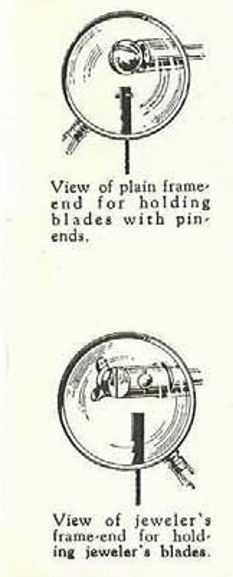
For thinner materials or to reduce the kerf and waste of precious material, there was also a special "Jeweller" saw frame which used regular pinless scroll saw or fret saw blades. It used screw clamps to attach the blades

In 1928 the series of American Scroll Saws was changed, the name "Boy" was dropped, highlighting the serious work this machine could do for very little and new and improved models were introduced and more variations added.


The instructions talked about the importance of bolting it down to the work surface (Yes, could be your dining room table, just saying :-)
and mentioned that it can be adapted to foot powered or electrical power.
Found a video of the giant model in action on You tube
But you could buy the saw unit mounted on a base.


Notice how the saw is bolted down to this cast frame.
Quick and easy tools swap. Notice also the "spare " motor shaft ...
They realized that by using the shaft on each ends they could easily produced a whole motorized workshop using various inexpensive attachments.
The first one were relying on you cutting a slot in your workbench of whatever length you needed to created a lathe bed. Mount the motor on one end, use one spindle for the headstock, the other for a sander or buffer. Put in a tail stock at the other end, a tool rest in between and voila! Instant Lathe. 10 minutes set up they claimed...after cutting the slot...

The little wonder bench
Of course if you did not wanted to cut a slot into your perfectly good workbench, they would sell you one.

These modifications were made possible by the belt groove around the flywheel.
This little thing, was the spark that started a "new" revolution in hobbyist woodworking; The multi combination machines.
In order to do away with the need to cut a slot in your bench and have more precision, a metal slotted table was introduced. The result was the Delta Handy-Shop

Recognize the red base for the lathe headstock/sander and tilting table saw?
Same shown above with scroll saw mounted.

The Delta "Electric" Handy-Shop, may have not been the first one, they had competition, but it was compact and affordable thanks to payments plan.

Use this handy order form and...

Pick a convenient payment plans to suit anyone...if you have a job...
Of course in those days the rural electrification of the US was not completed so not everyone had access to electricity. No problems, they thought of you, and had a model adapted to be driven by a small gasoline engine

Replace the motor by a 4 pulley unit, move the motor below, or instead of an electric motor install belt shafting and drive it by an gasoline engine


Here is an idea of the size of these units
The Handy-Shop, consisted of a Wagner grade motor, a steel-bed lathe, a disc sander and a scroll saw (the American Boy Scroll Saw)
Upon its introduction in 1928, the Handy Shop sold for US $99.50, which was a significant sum of money for that day and the Great Depression was just around the corner...

Despite its cost, it quickly became one of the most popular home workshop items in America.
Don't let its diminutive size fools you, you can build big things with it, such as full scale furniture, outdoor furniture and arbors etc.


A 4 in jointer and 8 in circular saw combination unit followed in 1929. It replaced the less efficient small tilting table unit for the handy shop
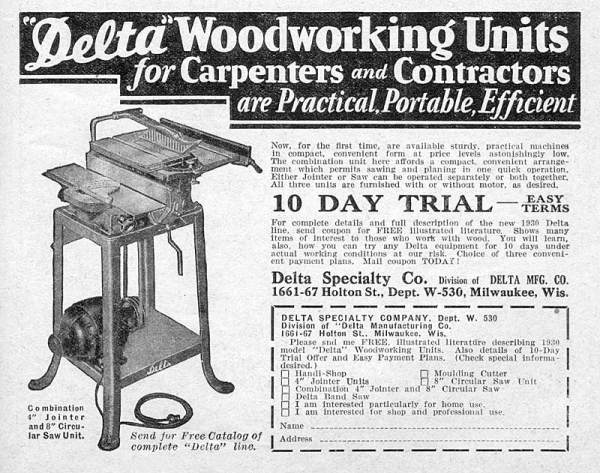
These combination units were very popular and manufactured in various sizes,
9 in tablesaw with 6 in jointer etc. up until the early 60s (Rockwell-Beaver)
Later there was a combination tablesaw, jointer and an horizontal boring machine all in one.

At this point, given the cost of ownership and the world about to go broke on a large scale, how could anyone afford these??
The answer of course was the introduction of payment's plans
As the US reached the height (or should we say bottom) of the depression, Delta machinery continues to forge ahead with new product introductions. The early 1930s proved to be a critical time in the company history because Delta machinery began focusing on band saws as one of its core products. Its first band saw a 12 inch unit, was launched in 1930. Shortly after a 10 in unit for the Handy Shop came out

Delta 1st bandsaw, a 12 in
Pic from Vintage Machinery


Delta 10 in bandsaw
Pic from Vintage Machinery

Delta Homecraft 10 in bandsaw
Pic from Old Woodworking tools
Which were quickly followed by the venerable Delta 14 in model.
Yes, that would be the 14 in model which has been copied by just about everyone else and is still with us today. My own 14 in bandsaw is a 1989 Taiwanese copy (King) of this old timer model. There as been some advances and modification to this design thru the years but it is still based on the Delta original design from 1934...

Delta original 14 in bandsaw. The one we are all familiar with in N.A.
It established a new standard 14 in throat clearance and 6 in throat capacity, which could be increased to 12 in by using a riser block... just like mine today
During those years, there was very little to none woodworking publications such as today's magazines. In order to fill a need and promoted its machinery, Delta introduced the Deltagram on a monthly basis.
That publication contained woodworking plans, tool talk and technique for aspiring woodworkers. Many of these original plans have been re-recycled in various forms thru the years in various magazines.

Sample from my collection of various publications on setting up shops, using tools and building things from the late 30s early 40s
Toolmakers quickly realized that it is one thing to built tools, you also have to create a need for them via education. Promoting woodworking as a hobby was a big part of that and one of a lasting legacy to these days. In those days following the great depression, numerous brochures, pamphlets, promoted making supplementary income by building things for sale. During WWII it became more about making do with "nothing" as imposed by severe restrictions on various war effort's essential materials. How to fix everything and building the stuff you could no longer buy was a big part of it also.
To this day there still exist a "Market" for Do It Yourselves (DIY) magazines, books, online publications and etc.
Combination machines still exist in various forms.
Lots of it can be traced back to the introduction of this little saw ... Some saw I'll say!
Bob, the historian who need to pay more attention to Rudy apparently... :-)


