Showing posts with label Brace. Show all posts

Saturday, November 10, 2018

Stanley No 811 brace

Friday morning I was running out of bread.  My favorite white bread around here is from a small bakery in Bridgetown (where Heather was born). So we did a bread run this morning. While we were going that way, may as well keep on trucking west to Annapolis Royal for a chocolate run Tm.

You know,  that little shop with the perfect business model for me:
- Hand made chocolate (delicious)
- A new/used book section (must have)
- And her hubby, Terry sells antique and specifically, tools (can it get better??, somebody pinch me :-)

It was so good to see Terry, up and around, gabbing about tools.  Its been a while I saw him, he is battling a serious illness.   While we were discussing something about Stanley, I spied a metal brace with a Sampson chuck on it?  Don't see that often around here.

So $20 later it was mine, no argument there.


Yes, it has some issues, hence the low price, with the enclosed ratchet mechanism (happens a lot, cause by the hardening grease they used back then), but little rust, some gunk, beautiful rosewood handle and head. Both the handle and the head turned, albeit slowly, sticky. Wanna guess what grease they used??
No biggies, I was satisfied that I could turn the ring and worked the ratchet both ways and lock.
Nowhere near what it should be, but easy fix... most of the time (Bob 8 - Brace 1)

So lets ID it and see what makes it tick.

Most often, you will find manufacturer name and Model No on the brace arm.

STANLEY
 Flip the arm over
No. 811-10IN-Y

So what we have is a concealed mechanism Stanley brace No 811 with a 10 inch sweep.
Incidentally, its siblings, No 810 is considered to be THE best Stanley braces, but don't take my word on it.  More later on this.

There was only three braces models in the 800 series .
The No 811 was manufactured between 1911-1942
It featured the following's patent during its run. (Walter 96)

24 Nov 1908 Bartholomew's concealed ratchet


13 Jul 1909 Bartholomew's Ball bearing chuck

16 Aug 1910 Schade's patent on the jaws (Universal jaws)

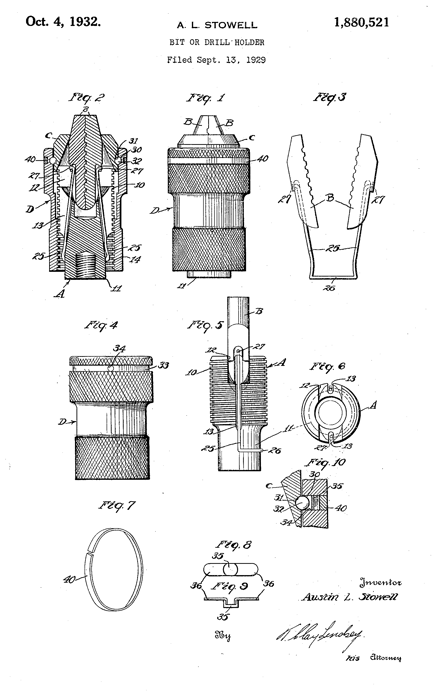
4 Oct 1932 Stowell's on the chuck (improvement on ball bearing chuck and modified spring for jaws)


It was nickel plated and featured a Cocobolo (which is in the Rosewood family and often confused with Rosewood) head and handle.
It came in 8, 10, 12, 14, 16 in sweep, the largest range in the 3 braces No8xx series

At the same time, the no 813 was also offered 1911-1947
It was billed as a Heavy Duty brace with a boxed ratchet and Universal jaws

16 years later, the last of the No 800 series came along, the No 810.
This was Stanley's Aristocrat of braces, featuring Bodmer's patent on the ratchet mechanism.


Bodmer Ratchet patent, as used on the No 810.
16 divisions (clicks) in one complete rotation, using vertical pawls.
Making it very low torque to operate and very smooth


Until then all the Stanley made braces featured the same concealed ratchet mechanism (811, 901, 921 etc.) The famed North Bros concealed ratchet braces would come after their take over by Stanley in 1946.


So the line came out as such
810 - 10, 12, 14 in sweep 1927-1935 (during the SW era)
811 - 8, 10, 12, 14, 16 in sweep 1911-1942
813 - 8, 10, 12, 14 in sweep 1911-1947

They produced a large variations of braces, but in the ratchet braces, they came in three flavour of ratchets, 3 variations of jaws and 3 ways to attach the head.

From LAP reproduction of Stanley Catalog No 34, 1914 edition

The three ratchets in question
From L-R
Concealed (No 811), Box (No 923) and Open (No 3410 PEXTO)

The three types of heads


Braces used in these examples
Stanley, No 811, 923, Pexto 3410, Stanley (Fray) No 108, oh and the Footprint

Back to our No 811

Nice chunk of Cocobolo

The ball bearing head has an oil port.
Stanley call that head style: Metal clad , bearing head
 on their best quality models


From a distance, to me that looked like a Sampson chuck, as often found on Pexto braces.
Turns out, that is something else... Bartholomew. 
Both featured a bigger nose because, they both have a ball bearing nose piece

The logo on the sleeve reads
STANLEY (in notch rectangle)
MADE IN CAN.
PAT. PENDING

Ok, so that dates it after 1907, the start of Stanley Canada, but which patent could it be??

The notch Rectangle with Stanley inside first came out with the SW  era

With some minor variations this last between 1926-1932 and thereabout

The notch rectangle makes it late 20, early 30 at the earliest
Pat. Pending

The oldest patent attributed to this model that was applied for was on Sep 13, 1929
Surprise, my chuck has such a feature after I cleaned it

So it would appear that the patent in question is US Patent 1,880,521
Issued Oct 4, 1932
Ring is segmented, covering the bearing race opening
Pic is after I cleaned it

That would then dated my model to:
Between Sep 13 1929 (Pat Applied for, or Patent Pending) to Oct 4th 1932 (Patent issued)

I gave it a quick clean up on the drill press with my wire wheel

First, I tried to remove the head, to protect it from the wire brush.
With all three screws out, head is still solidly wedged in there.
looking at catalog copy, it almost seems like the head is screwed in (wood threads)??

After going over the brace frame and chuck with the wire brush, opened up the chuck
It featured the Universal jaws, mounted on a spring.

That spring shape is from our patent of 1932
Carefully remove the spring with the jaws without bending it out of shape.
The jaws are removed from spring in this pic.
DO NOT loose these parts...

The chuck was dirty inside and a tad gummy.
Soaked good with Krud Kutter and waited a bit.

Cleaned the inside with the round brush, wrapped in a shop towel.
Reamed inside, rinse and repeat (almost literally)

I am happy with the inside.
That is when I realized the nose part rotated separately from the shell...
See Patent above

Before reassembly, I lubricated all the moving parts with a special lubricant

Pic was taken before I cleaned it.

That JIG-A-LOO stuff is extremely slippery, watch out where you spray it. I makes wooden floors and laminated flooring very, very slippery. Forgot where the spot is?  Just wear wool socks and walk around the floor. Were you slip and broke your leg mark's the spot... You been warned :-)

Is it really that slippery? Heck, it works miracle on tools!!

A tad smelly in an enclosed space (if you go nuts and do a few more tools),
 but thankfully I can open my new windows :-)


So putting down a piece of cardboard on my shop floor, then putting the brace on it, I sprayed the selector and mechanism, the handle bushings, the head bearings and the inside bearing in the shell
I sprayed some WD40 on the threads for the shell then re-assembled the whole thing.
A tad overkill, since Jig-A-Loo is like WD40 plus a lubricant.

The selector and mechanism, took two rounds of Jig-A-Loo sprays, but it is now purring correctly.


I am the proud owner of one of the Second best Stanley made brace (this No 811),
Model No 810 with its innovative 16 notches ratchet (Baby smooth), is still justifiably, No 1

So lets make some holes, No 2!
Aye Aye Capt

A tad heavy on the ratchet side, but works like a champ
This brace weigh in at a hefty 3 pounds plus!!
It is screaming, I came out of a machine shop, not the forging floor! :-) 

It can then take its place inside my boring till

And I see that the brace besides it need some buffing at the wheel...
Done!


Bob, off to the garage to clean another one, and another one...

Saturday, October 28, 2017

Footprint Model 170 brace

Another fresh find, this one is practically unused and in NOS (New Old Stock) condition, well almost...

Its from the seasonal flea market in Wilmot, same vendor from whom I  have been getting some good braces and Hand drills lately. Including that mechanical marvel, the North Bros 1545, I sent to Gerhard. When I see her, now I just ask her what she got for tools and she shows me stuff she has not unpacked yet, for lack of space. I guess you can say, I get 1st dibs  :-)

Today, when she shown me this brace, I was immediately taken aback how new it looked, yet, it is well made in the older tradition. No plastic, all metal, plated with wood (Beech, no stain, varnished), ball bearings in the head, ink markings almost perfect etc. For $20? Did not even bothered haggling for it, take my money please.

See anything wrong yet?

Footprint
Sheffield
England

Footprint ratchet brace
No 170
10 in sweep
BS1978

NO, that brace is not dated 1978, it reads British Standard (BS) 1978.
This just happened to be the BS for Hand Brace. The BS1978-1953 was later replaced by BS1978-1965 which is still current. That brace was more than likely made after 1965, still under that last edition of this standard.

With the old masking tape removed

wiped off with GOOGOO GONE.
It stink, but it is very efficient.
There is a faint discoloration under the tape, 
it's been there for a while. It will gradually dissapeared under the UVs


The ratchet mechanism look pristine and work like a charm.
Good strong springs on the jaws

By now, you would be thinking, it's perfect right?  I wrote about this before, but in the hunt for tools, we often overlook glaring defects or omissions, while being mesmerized by what you just found, you quickly develop selective blindness...

See it yet?

Huh? What is that gap??

What? I need a common and a Robertson Red screwdriver??
Obviously a prior Canadian Mod...

The plate is wavy, that is why the gap.
Notice the wrong size Robertson screw of the wrong type.
Its a tapered woodscrew versus a flat head commun slot screw

Not the first time removed for sure.

Now, this oversize Robertson wood screw and the gappy head were pretty glaringly obvious, how did I missed that ? All too easily :-) 

So off to the stores I go to find some suitable screws.
Kinda got some, but not surprisingly, all the screws were Robertson heads... or were they... The UPC shows up when scanned as SQ-DR Argggg American inferior copies of Robertson being flogged upon an unsuspecting public....S.O.B

Anyway, for now all I have are a bunch of woodscrews with the right head but Robertson Green (?) versus slots, oh well, at least it is not so glaring anymore.
I'll keep looking, must have some, somewhere....

Hoh, and I flaten the platen. It was wavy allright. I simply squezzed it in a metal vice, line with a folded sheet of paper to protect the plated finish and rotate, squezze, rotate squezze etc until a lot more flat...

Removed screw, besides.
Now plate seat flush all around

The Footprint tools that we still know today, started with a merger in 1968, using that familiar footprint symbol. The company goes as far back as 1760 under the name Alfred Ridge & Sons. They are I believe one of the few remaining old Sheffield hand tools makers.

From the company website

All in all, this is a solid brace, practically unused and pristine except for a glaring booboo under the head, well worth the asking price. That one will probably go to one of my son's toolkit.
I better start making the tool boxes soon...
But thankfully, they each have a finite number of my Ahem, essential toolkit :-)

Bob, the blind tool hunter

Wednesday, October 25, 2017

Wooden braces

It took me a long time to acquired my first one, a Sheffield plated brace, from Ebay back in the days...

Lately, they seems to pop up more often in my local searches, go figure...!!!
I wrote earlier about the development of the brace, here

I only made provision for one wooden brace in my ongoing Boring till, but I now own 4.

All lined up to give you an idea of relative sizes

The first one to arrived about 15 years ago, via EBay, was this Sheffield plated brace manufactured by Abbot.


It feature the button chuck, which relies on a notch cut on one side
 of the tapered square tang of the brace bit.

Next was another local finds, last year, while out buying handsaws, responding on a Kijiji sale... When I asked if he had anything else, this is what I spotted.
This one was manufactured by Barton


Also featuring the ubiquitous button holder.
Since there was no real standard, the location of the notch required varies.
In this pic, the bit inserted does not goes deep enough.

Then came across this bit pad unmarked drill.


It uses the familiar clothes pins, spring pad, 
which are Missing In Action on this one :-(

Would have to try making some, some day.

So called because of their ressemblance to the 
older traditional wooden clothes pins.
Pic from Etsy

Similar braces also are seen with a simpler tapered interference fit pad, no spring.
That work fine while drilling, putting pressure on it, but if the bit get stuck, it would pop out from the brace, hence why someone came up with those clothes pins springs.

And more recently, this past Monday actually, came across this unmarked chairmaker brace. So called because they used spoon bits, the prefered chairmaker boring bits. The bit is a tad bent, but when I tried it, it cut a nice round hole, will not try to straighten it and risk breaking it...

The hole it drilled effortlessly thru cherry.
With the added rim being countersunk by a Stanley No 18 bit.
Both cut surfaces as is from the existing, unretouched, cutting edges.
A testament to the robutness of this design, 
"protecting" the cutting edges this long.

This style of "Chairmaker's braces" were prefered by the chair makers who only used a few sizes of holes, and could get by with 2 or 3 of those braces. The bit being permanently attached, it is always ready to go. That style lingered on for a long time after it came and went.


Sized just right for the delicate spindles 
of a Windsor chair for example

These last two came up during my regular bread runs to Bridgetown. I love the white bread made by a small bakery there (Graves), well worth the run. And since Bridgetown is already, roughly, half way to Annapolis Royal, I often goes there for my tools...err I meant chocolate runs at my favorite little shop. They have home made chocolate, a used books section and some antiques, with a small section devoted strictly to tools. Perfect business formula for me, it hits all my buttons... Oh and Jean and I like the chocolate also and Rudy comes along for his daily car rides :-)

And I guess that makes me a regular customer... :-)

Bob, bracing for a shortage of room in my upcoming boring till...
Humm I think I need a bigger wall :-)