Saturday, February 11, 2017

Scratch stock

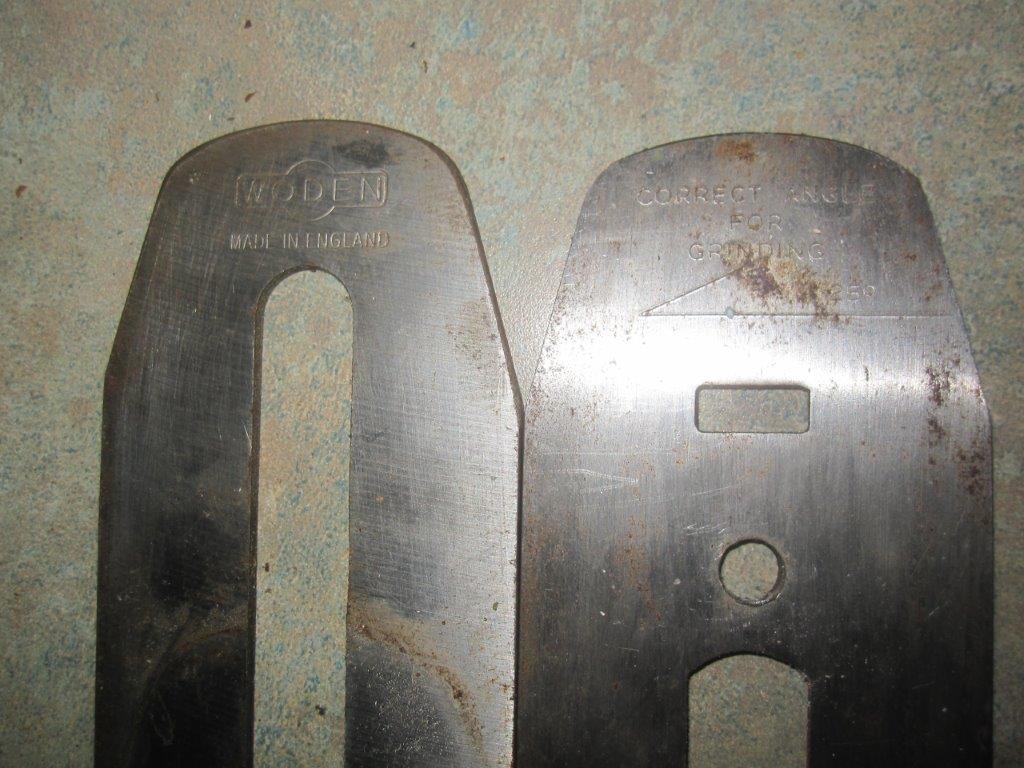
Traditionally small moldings profile were simply scratched on the edge of the pieces, while bigger profiles are executed using a plane.

From L-R
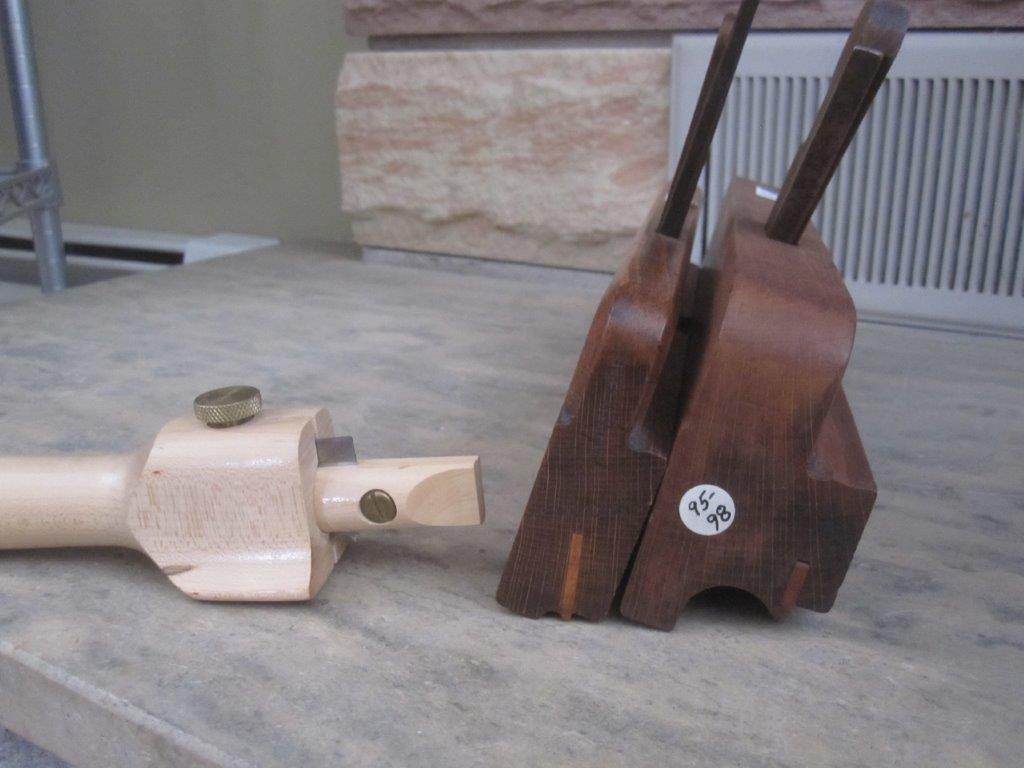
1/4 in beading plane and 1 inch (8/8) beading plane
Flat part on the right is the depth stop

Same profile, a bead, on a scratch stock

They are called scratching tool due to the vertical position of the blade, and scrape rather than plane the profile.

There are many ways to make and use a scratch stock, and they are used somewhat like how you would uses a marking gauge. Sometimes you come across old marking gauges which had been modified to hold a scratch cutter by cutting a slot at the end of the beam closed by a screw or two. They have a stock, or beam, to hold a small steel cutter vertically and a fence to control the location of the profile. They would be almost impossible to use without a fence and make a straight profile, unless there is already a profile started or by using a batten on the piece of wood as a guide.

A straight fence allow you to guide the tool on a reference edge and a curved fence around a curved profile, either concave or convex. Hence they sometimes comes with a removable fence: a straight one and a curved one. E.G. Stanley No 66. Of course having loose parts often meant that the fence(s) often get lost thru the years...

In use they are tilted forward in the direction of the cut, making the cutter trailing. The final profile being scratched vertically. They can be used either by pushing away from you or pulling toward you. In order to do that, the beam must be tapered or rounded.

The last few pass vertically is important if you want to reproduce exactly the cutter profile. For example when rehabbing a moulding plane sole profile.
When you tilt a circular profile you are cutting more of an ellipse than a circle.

Sharpening is mostly done by rubbing the flat faces on a polishing stone, eventually you will have to touch up the shaped profile, or to create your original profile, for which a chain saw file would be small enough to do the job, you can uses shaped slipstones, diamond files etc. The profile is filed straight across, so when one side of the cutter is getting worn, simply reverse the cutter to get a fresh edge. A sharp cutter has a sharp arris between the flat face and the edge.
A good source of spring steel to make cutters would be from an old saw blade, either a bandsaw or a handsaw, old card scrapers and etc.

Being very simple to make using shop scraps, they were often craftsman's made.
Here is another similar version. The idea is to cut a narrow kerf to slide the blade in and out exposing the right amount of the profile desired. The blade is secured by closing the kerf with a screw pressure.

The Hock tool version
Pic from Amazon

Paul Sellers poor man versions: a Beader using similar methods as above or using a screw as the cutter 

As you can see there are very easy to make,  but you know there has to be a way to invent a better mousetrap....
And so there were ...

Probably one of the first patented and manufactured scratch stock were the Windsor beader or scratch stock.


First patented Windsor beader 

Patented by Lawrence Poole in 1885,  and made in Windsor, Vermont (why we call them Windsor beader or scratch stock), the first version sport an all wood body and fence in one piece.

The first wooden version as my example above

The later metallic version perhaps better known. There has been modern reproduction of this tool in later years and cutters are sometimes available new for it. Pics from DATAMP 

The rotary cutter disc, present 6 different profiles around its circumference. The various profiles are selected by slackening the nut that press the cone against the cutter, turning it until the desired profile is sticking out by the fence, then retighten the nut. The fence is fixed hence it is only designed to work on the edge of the boards. Later models have a movable metallic fence.
See Lee Valley newsletter Vol 6 No 6

Stanley came out with its No 66 scratch stock 1886-1941, it is often found missing its cutters (6) and the fences (2). Fortunately Lie-Nielsen has been making a reproduction and the parts are interchangeable

The Lie-Nielsen version of Stanley No 66.
The bent blade, rarely seen in the wild, is a two ended router blade.
Pic from Lie-Nielsen site

Stanley also had the smaller No 69, which is fence less and designed to be pushed only, since the blade is leaning forward. Being fence less it can be used anywhere on the board, providing you use a batten board as a fence.

Stanley No 69, was never much popular owning to its difficult useage, 
hence rare and valuable.
Pic from Patrick Blood & Gore

Preston had a metallic one as well, No 1393S (1909) which is now being reproduced by Lee-Valley.
There was a short lived version in bronze made by Woodcraft earlier. (Early 2000s) which came with two (2) fences.

The original Preston No 1393S, from 1909 catalog

Lee-Valley also came out with their own designs, first in wood then in metal with wood handle and finally their Preston reproduction
All three versions used the same blades, bonus!

The original wooden version along with their latest reproduction

The blade can be bury in the fence to reveal the profile desired

The beam at full extension, the blade can also be secured in another position, hence the three (3) screws. The beam is round hence can be tilted in use.


Similarly on this one, the sole and the fence have a small curvature to them, enabling the tool to be tilted in use and to go around curve edges

LV third version also uses the same blades set (8) as the two others
Pic from LV site


 A close cousins to the scratch stock are another class of tools called Coach routers or Quirk routers used in the coachmaker trade. They were used to scratch the small profile around curved members on the coach. Often cutting a narrow groove, (routing) to insert an inlay contrasting piece of wood.

Preston Quirk router.
Cuts a narrow groove
Pic from EBay

Preston Sash routers
From T-B Bead, Ovolo and Lamb tongue
Pic from HTPAA.ORG.AU

Notice the two cutters? There are mirror image of each other and allow you to attack the grain from both directions. There are also unique by having a short sole surface, like a plane. Preston seems to had been the only maker of these unique tools. Pic from EBay

These small profiles exist for a very good reason, it prevent wear on the edges of the pieces, because there are no sharp arises left, but rather a small rounded over.

Notice the wear on the top edge of my dado cutters storage box I made back in the 90s. I was supposed to make a cover or lid but never got around to it :-) 
A small bead detail would have prevented that, hence why often used on top front of drawers or on shelves front edges

Some scratch stocks can cut small flutes or reeds in the middle of small parts ( think table or chair legs) if they have a movable fence.

Scratched profile on front of dining chair's legs.
Accent carving on stretchers by Rudy :-)

Another similar types of tools are used to scratch or rout out small narrows channels for inlays .

Do they still have a place in our modern shops? Well, you try to balance a high speed rotary tool (electric routers) on a small narrow piece and let me know how you make out...

One last thing, owning to their rotary profiles and rotation speeds, a router bit cannot cut some of the more delicate profiles made by a simple scratch stock or beader tool.

Scratching the profiles is also quieter and often faster than using them 'Lectric screaming beast :-)

Bob, scratching Rudy ears :-)

Monday, February 6, 2017

Woden No W5 Jack plane

Another recent Kijiji finds, an almost perfect specimen still in the cardboard box with the instructions pamphlet. It was a bit out of my way, Truro NS, but it was a good ride in the country side, and it so happened that one of my girlfriend sisters lives in Truro, so great excuse for a visit. Thank you Crystal and Paul for the hospitality :-)

Black covered paste box with yellow label.
I gave it a quick wipe, it was quite dusty... Coming from a typical powered woodworking's shop :-)

What is inside, complete with plane pamphlet


The Woden company of Wednesbury Staffordshire (1868-1961) was a maker of a limited range of hand tools for woodworking such as ratchet braces, carpenter bench cramps (vises) flooring cramps, wrenches etc. They had a steel foundry and were equipped to make all the parts required to make hand tools. The hand tool division was relatively small within the overall product range, of metal castings, nuts and bolts and related steel products.

Like most British companies that were heavily involved in the war effort (WW2), the company struggled to return to normal products production due to a shortage of raw material and qualified manpower.

They did not manufactured metallic planes until 1954 after acquiring WS Birmingham in 1952. Part of this acquisition gave them the redesigned copy of the Stanley No 78 Duplex Rabbet plane, the dual fence rail WS78, which would later becomes Record 778 after Record purchased them in 1961.

Paul Sellers really like them so you know they are every bit as good or better than Stanley and Record.

Their planes offering grew to includes two Block planes the W110 and W130

Bench planes:
Smoothers W4 and 4-1/2
Jack planes W5 and 5-1/2
Fore plane W6, and
Jointer plane W7
They never produced size No 2, 3, 5-1/4, 8
They also made some corrugated sole bench planes until 1963
And of course the better copy of Stanley No 78, the W78 Duplex Rabbet plane.

This was a somewhat limited offering compared to Stanley and Record, but in order to compete they had to produce a high quality and finish product, which they delivered. They are as good, and in the case of the W78, better than the originals Stanley and Record copies (No 078 specifically)

In the early 60s Record was expanding by purchasing rivals manufacturers, they acquired Woden in 1961 and moved operations to Sheffield.

Early on the planes had a mixture of parts from the old Woden's parts and the newly produced ones from Record.
Gradually, all parts were being made solely by Record, with a few small modifications in materials and design.
Record continued to produce the Woden range under that name until about 1965
Other products were continued under Record own model numbering, such as the W78 which became Record No 778.

Lets see what we have here and try to narrow it down to a period of manufacture.


According to this site there are 5 different productions variations, or Types:
As usual for these Types studies, it is based on the No 4 (W4)

Three (3) from Woden and the last two (2) when Record took over:

Type 1 - 1954-55, early production,

- Bodies without "QC" or "Q" foundry marks (in house Woden foundry)
- W4's with single lower pane frogs
- 2 inch frogs with small (4mm) marks
- 2 in lever caps with inside lower flat or rounded bottom edges
- Type 1 or 2 cutters
- Type 1 Label (L1) boxes and Woden Plane Instruction pamphlet (WPI 2 or 3)

Type 2 - 1955-57

- Bodies without "QC" marks (in house)
- 2 inch frogs with 2 lower panes, without "Q" marks but with single 5.5 mm       marks
- 2 inch lever caps without inside bottom flat, with or without rounded bottom edges
- Type 1 or 2 cutters
- Type L1 boxes and Type 2 or 3 Woden Plane Instruction pamphlet

Type 3 -  1957-61 late production

- Bodies including the "Q" or "QC" foundry marks (out sourced to Qualcast foundry)
- Frogs with "Q" marks and 5.5 mm marks
- 2 inch lever caps without inside bottom flat and square corners
- Type 2 or Type 3 New Improved Cutters (NIC)
- Type L1 or L2 boxes with or without NIC label, and
- Type 3 or 4 Woden plane instruction pamphlet

Type 4 - 1961-1962 Early Record production, the change over period

"Changeover" planes were being assembled in Sheffield (Record) with Wednesbury made parts (Woden). There were problems with Record using a mix of Woden and Record manufactured parts that were using different screw threads. Woden used mainly BSF screws and Record  used the historic Stanley and BSW threads. This resulted in some re-machining and or a few special "one of" parts to be found

- "WODEN" and "No Wx" cast marked on either a Woden or Record shaped body
- Either Woden or Record specified frog
- Woden Type 4 Tungsten Vanadium cutter with stamped marks
- Either Woden original or Record modified lever caps
- Either Woden or Record wood parts with the original Woden transfer slide decal affixed to the handle
- Either Woden or Record specified depth adjustment wheel with appropriate screw or
- Unusual pattern of depth adjustment wheel with Woden screw

Type 5 - 1962-65 Record production until discontinued

- A Record body shape with just "No 4" in front of, or behind the knob and NO "Woden" cast marks
- A Record type frog having a thicker USA UNF thread depth adjustment screw
- Record unmarked adjustment wheel
- Record 3 pieces lateral adjustment lever with a bottom fixing rivet
- A lever cap with either a Woden cast mark with a red or orange background
- Later Record production had no Woden cast marks but a simple transfer decal near the top
- Lever cap handle is shorter and curved is more pronounced. Woden made had a lever length from cam boss to tip of about 29 mm, Record about 26 mm
- Record wood parts with Woden transfer slide decal on the handle top
- Record small parts: Cheese headed frog screws, straight frog clip with round
 head screw and Record BSW ended studs for the handle and knob

My example as found:

L2 box (black) and label 1957-61/62

Water slide transfer decal, intact and pristine
Type 4 1961-62


Pristine frog surface

Upper quadrant marked "Q" on left, "7" on right 

Three (3) piece Lateral adjuster. 
Earlier Woden had a simple bent tab at the end of the lever


Cutter Full size , still showing original grinding marks, 
never sharpened.

Woden Type 4 Tungsten Vanadium cutter with stamped marks. 

Square bottom edge on lever cap Type 3 1957-61.
"Woden" red paint, "Record" had more of an orange paint.
From about 1956-7, the plating improved and did not easily flaked and resist corrosion better. This thing is perfect...

Less pronounced and longer curved lever.
The shoulder cam is higher 51mm versus 48mm 

Knob and tote have some finish flaking off. Lacquer, Shellac or Varnish? 
I see this typically on Record tools.

High knob and tote, stained and lacquered (?) hardwood

Frog receiver with frog adjuster screw

Frog adjuster screw has square end (Woden)
Later Record has a more pointed end like a set screw.
This is just about the only rusted screw on the whole plane.

Notice the slight angle machined on the frog for the clip.
Frog capture clip is angled with a straight clip (Record), Earlier Woden had a near vertical casting and an angled clip

Lever cap screw has the Record longer non thread portion 

Front toe casting shows WODEN and No W5
Later Record made models had only No 5 cast in front of knob
Knob shows waisted barrel nut, earlier were plain cylinder.

Rear casting has MADE IN ENGLAND
and QC 2 stamped inside the tote receiver

Side show some minor discoloration

Sole has virtually no scratches

This side shows the most discoloration, light surface rust 
should easily cleaned up


Everything point to an earlier Type 4 1961-62 Changeover period plane.

The japanning is in perfect condition, there are some small stained surfaces here and there on the bright metal parts. The level cap is just like new, the iron is unused and full length but has some small chips at the cutting edge. The wooden parts, tote and knob have no defect except for flaking off protective coating (shellac or varnish) here and there. The box is in good shape but the pamphlet has some rust stains on it. All in all, an unusual find in great shape. I don't often run into these. Quite the score : -)

Well worth the travel to Truro and got to spend some quality time with Jean's sister Crystal and her husband Paul... Bonus :-)

Rudy awaiting the return of his beloved Jeanie.
Everytime he hear a vehicle in the yard he rushes to the window :-)

Bob, who had a biopsy of the prostate this afternoon... Another cancer scare? Bring it on, i'll fight you till the end!! This would be round 3 for me with cancers, Heather had 2.  I am not worry but getting frankly tired of it all... :-(